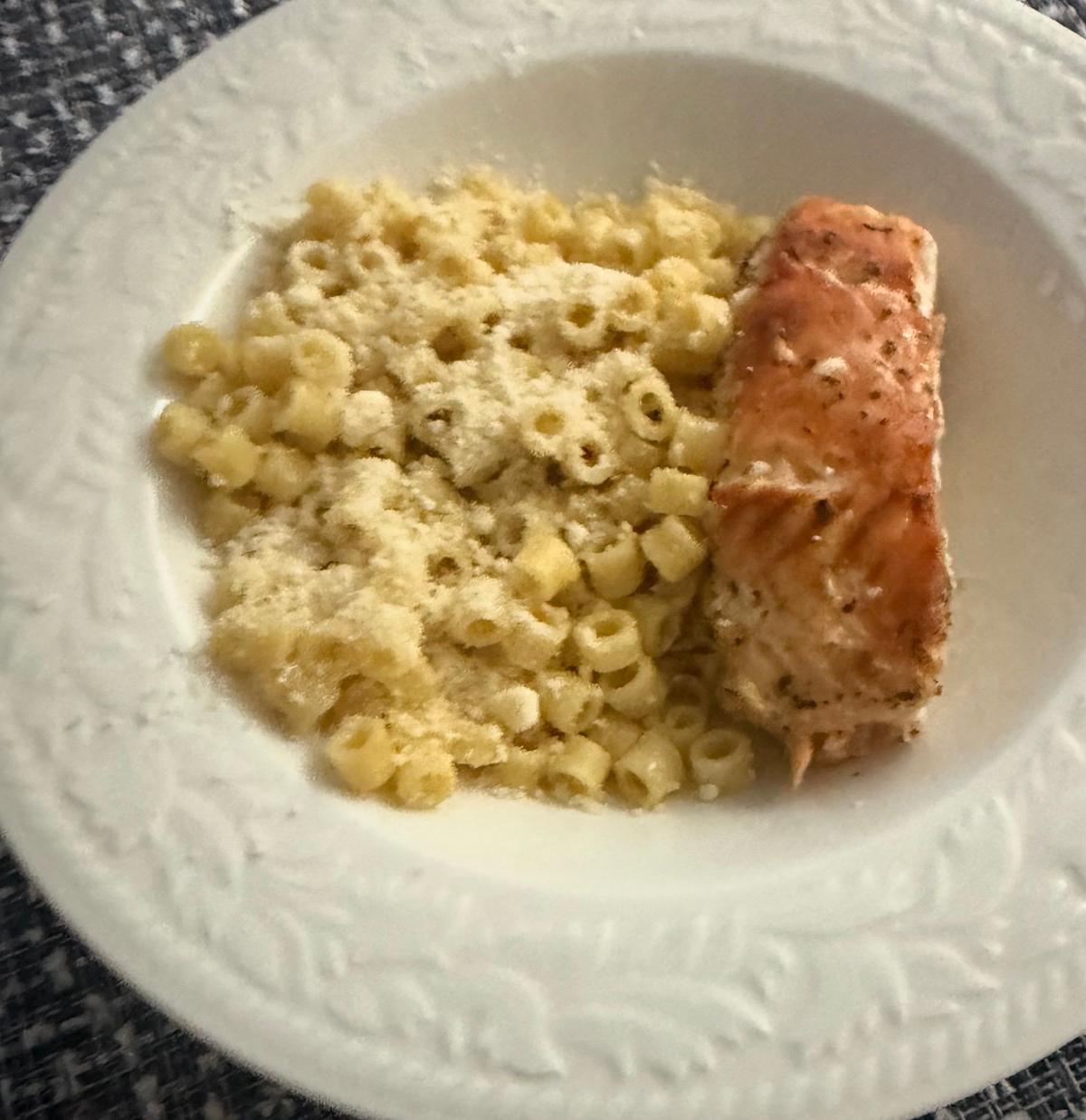
Creamy Ditalini Mac & Cheese with Pan-Seared Salmon
Tiny ditalini pasta rings swim in a velvety, Parmesan-laced cheese sauce that clings to every ring, while a golden-crusted salmon fillet — seasoned with herbs and seared to flaky perfection — rests alongside for a protein-rich, restaurant-worthy bowl. The richness of the mac and cheese plays beautifully against the savory, slightly crispy salmon skin. It's an elevated weeknight comfort meal that comes together in under an hour.
- Total time
- 45 min
- Servings
- 4
- Calories
- 720
- Protein
- 52g
Ingredients
- 4 pieces skin-on salmon fillets (about 5–6 oz each, 1-inch thick)
- 2 tbsp olive oil
- 1 tsp kosher salt
- 1/2 tsp freshly ground black pepper
- 1/2 tsp garlic powder
- 1/2 tsp dried Italian herbs (or dried oregano)
- 1/4 tsp smoked paprika
- 12 oz ditalini pasta (small ring-shaped pasta)
- 1 tbsp kosher salt (for pasta water)
- 3 tbsp unsalted butter
- 3 tbsp all-purpose flour
- 2 cups whole milk, warmed
- 1/2 cup heavy cream
- 1 cup finely grated Parmesan cheese (freshly grated, not pre-shredded)
- 3/4 cup sharp white cheddar cheese, freshly grated
- 1 tsp Dijon mustard
- 1/4 tsp garlic powder
- 1/2 tsp kosher salt
- 1/4 tsp freshly ground black pepper
- 1/4 cup freshly grated Parmesan, for garnish
Instructions
- 1
Remove the salmon fillets from the refrigerator 20 minutes before cooking so they approach room temperature — this ensures even cooking all the way through. Pat each fillet completely dry on all sides with paper towels; any surface moisture will cause the salmon to steam instead of sear, preventing that gorgeous golden crust.
- 2
In a small bowl, combine 1 tsp kosher salt, 1/2 tsp black pepper, 1/2 tsp garlic powder, 1/2 tsp dried Italian herbs, and 1/4 tsp smoked paprika. Sprinkle this seasoning evenly over all sides of each salmon fillet, pressing gently so it adheres. Set aside on a plate.
- 3
Grate all your cheeses now before you start cooking — freshly grated cheese melts far more smoothly than pre-shredded (which contains anti-caking starches). You need 1 cup finely grated Parmesan and 3/4 cup grated white cheddar for the sauce, plus an extra 1/4 cup Parmesan for garnish. Set aside separately.
- 4
Warm the 2 cups of whole milk and 1/2 cup heavy cream together in a small saucepan over low heat for about 3 minutes, just until steaming but not boiling (you'll see wisps of steam rising and tiny bubbles at the edges). Warm dairy prevents lumps when added to the roux. Remove from heat and set aside.
- 5
Fill the large 6-quart pot with at least 4 quarts of water and bring to a rolling boil over high heat — this should take about 10–12 minutes. Once boiling vigorously, add 1 tbsp kosher salt; the water should taste pleasantly salty like mild seawater. Add the 12 oz ditalini and stir immediately to prevent clumping.
- 6
Cook the ditalini according to package directions minus 1 minute (usually 7–8 minutes total), stirring occasionally, until the pasta is al dente — it should have a very slight firmness at the center when you bite one. It will finish cooking in the cheese sauce. Reserve 1/2 cup of starchy pasta water before draining, then drain through the colander. Do not rinse the pasta.
- 7
In the medium 2-quart saucepan, melt 3 tbsp unsalted butter over medium heat. Once the butter is fully melted and just starting to foam (about 1 minute), add 3 tbsp all-purpose flour all at once. Whisk constantly and vigorously for 1 full minute — the mixture will look like a pale, thick paste and smell faintly nutty. This is your roux; cooking it for the full minute eliminates the raw flour taste.
- 8
While whisking constantly, pour the warm milk and cream mixture into the roux in a slow, steady stream — adding it too fast causes lumps. Whisk until completely smooth after each pour. Once all the liquid is incorporated, increase heat to medium-high and continue whisking until the sauce thickens enough to coat the back of a spoon and leaves a clean line when you drag your finger across it, about 4–6 minutes.
- 9
Reduce heat to low. Add 1 tsp Dijon mustard, 1/4 tsp garlic powder, 1/2 tsp kosher salt, and 1/4 tsp black pepper, whisking to combine. Add the 1 cup grated Parmesan and 3/4 cup white cheddar in two additions, whisking between each addition until completely melted and the sauce is glossy and smooth. Do not let the sauce boil once the cheese is added — high heat causes the proteins to seize and the sauce to turn grainy.
- 10
Add the drained ditalini to the cheese sauce and fold gently with the wooden spoon until every ring of pasta is coated. If the sauce seems too thick, add the reserved pasta water 2 tbsp at a time, stirring, until you reach a creamy, flowing consistency. Keep the mac and cheese on the lowest possible heat setting, covered, while you sear the salmon.
- 11
Heat the 10-inch cast iron or stainless steel skillet over medium-high heat for 2 minutes until very hot — hold your hand 3 inches above the surface; you should feel intense heat radiating up. Add 2 tbsp olive oil and swirl to coat. The oil should shimmer immediately and begin to move fluidly across the pan. If it smokes aggressively, reduce heat slightly.
- 12
Using kitchen tongs, carefully place the salmon fillets skin-side UP into the hot skillet, laying them away from you to avoid oil splatter. Press gently with the tongs for the first 10 seconds to ensure full contact. Do not move the fillets — let them cook undisturbed for 3–4 minutes. You'll see the flesh changing color from translucent pink to an opaque peachy-white, creeping up from the bottom. A golden-brown crust should release naturally from the pan when ready.
- 13
Flip each fillet carefully using tongs. The top should be beautifully golden and crusted. Cook flesh-side down for another 2–3 minutes, depending on thickness. The salmon is done when it reaches an internal temperature of 125°F (52°C) for medium (slightly translucent center) or 145°F (63°C) for fully cooked (opaque throughout, flakes easily with a fork). Err toward 125–130°F for the most moist, restaurant-quality result. Remove from heat and let rest on the pan for 1 minute.
- 14
Taste the mac and cheese one final time — adjust salt if needed, adding 1/4 tsp at a time. Ladle a generous, heaping portion of the creamy ditalini mac and cheese into each wide, shallow bowl, spreading it to cover most of the bowl's base.
- 15
Place one seared salmon fillet alongside the mac and cheese in each bowl, leaning it slightly against the pasta so it stays upright and shows off the golden crust. Dust the top of the mac and cheese generously with the reserved 1/4 cup freshly grated Parmesan so it snows down in fine wisps. Serve immediately while everything is piping hot — the mac and cheese sets quickly as it cools.
Tools you’ll need
- large pot (at least 6-quart) for boiling pasta
- colander
- medium saucepan (2-quart)
- 10-inch stainless steel or cast iron skillet
- whisk
- wooden spoon or silicone spatula
- sharp chef's knife
- cutting board
- box grater
- measuring cups and spoons
- kitchen tongs
- instant-read thermometer
- paper towels
Cook smarter
Get matched recipes for what’s in your fridge
CookSnap is a free iOS app that finds real recipes from the ingredients you already have. No more grocery-list aspirations.