Crispy Pan-Fried Polenta Planks
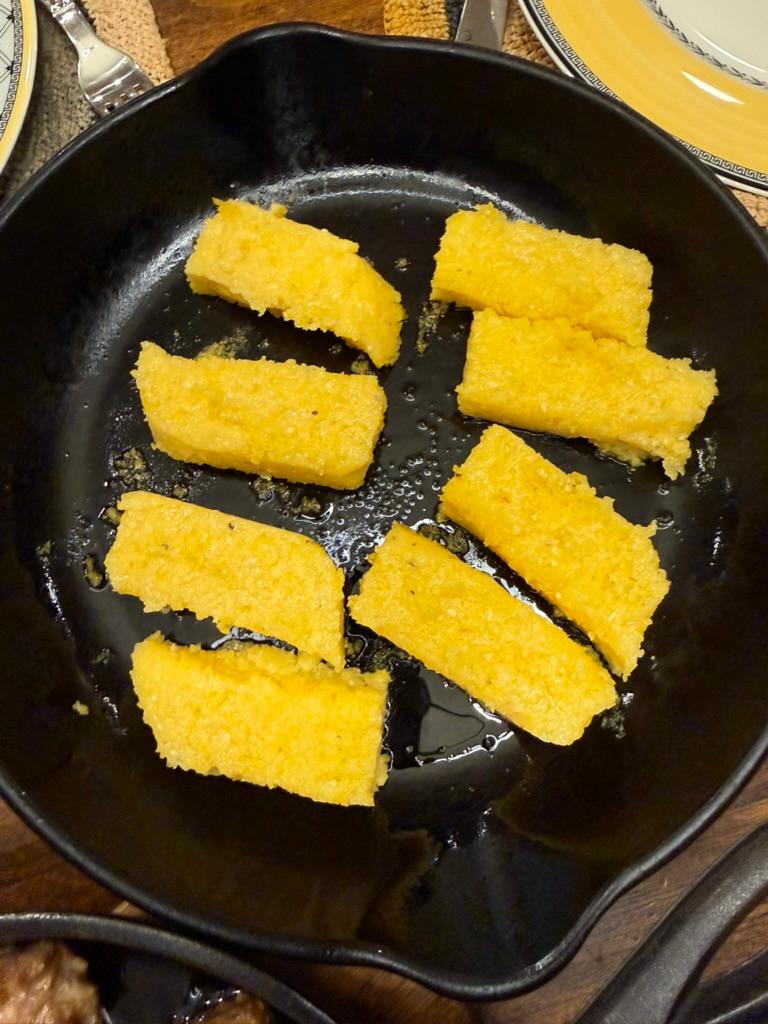
Golden, crackling-edged polenta planks with a satisfyingly crunchy exterior and a creamy, tender corn-scented interior — this is Italian comfort food at its finest. Made by cooking polenta from scratch, chilling it into firm slabs, then searing in a hot cast iron skillet until deeply caramelized, they make an irresistible side dish or appetizer base. Once you taste that contrast of crisp crust and pillowy middle, you'll never reach for store-bought tubes again.
- Total time
- 105 min
- Servings
- 4
- Calories
- 310
- Protein
- 7g
Ingredients
- 4 cups water
- 1 cup whole milk
- 1.5 tsp kosher salt
- 1 cup coarse-ground yellow cornmeal (polenta-style)
- 2 tbsp unsalted butter
- 1/4 cup finely grated Parmesan cheese
- 1/2 tsp freshly ground black pepper
- 1/4 tsp garlic powder
- 3 tbsp extra-virgin olive oil
- 2 tbsp unsalted butter
- 1/2 tsp flaky sea salt
Instructions
- 1
Lightly grease a 9x9-inch baking dish with butter or cooking spray and line with a sheet of plastic wrap, leaving overhang on all sides — this will make unmolding easy later. Set aside on a flat, stable surface.
- 2
In a medium heavy-bottomed 3-quart saucepan, combine 4 cups water, 1 cup whole milk, and 1½ tsp kosher salt. Bring to a full rolling boil over medium-high heat, stirring occasionally, about 7–9 minutes. Watch carefully — the milk can cause the liquid to foam up; reduce heat briefly if it threatens to boil over.
- 3
Once the liquid is at a full boil, reduce heat to medium-low. Slowly pour in 1 cup coarse-ground yellow cornmeal in a thin, steady stream while whisking constantly with your other hand. This prevents lumps from forming — do not dump the cornmeal in all at once.
- 4
Switch from the whisk to a wooden spoon or silicone spatula once the polenta begins to thicken (after about 1–2 minutes). Continue to stir vigorously every 30–60 seconds, scraping the bottom and sides of the pan, over medium-low heat for 20–25 minutes total. The polenta is done when it pulls away cleanly from the sides of the pan, holds its shape briefly when mounded, and no longer tastes grainy or raw. Be careful — the thick polenta can bubble and spit hot droplets; use a long-handled spoon and oven mitts if needed.
- 5
Remove the saucepan from heat. Stir in 2 tbsp unsalted butter, ¼ cup finely grated Parmesan, ½ tsp black pepper, and ¼ tsp garlic powder. Stir vigorously for 1 minute until the butter is fully melted and the cheese is incorporated — the polenta should look glossy and smell rich and savory.
- 6
Immediately pour and scrape the hot polenta into the prepared baking dish. Use the back of a spatula or a damp hand to smooth it into an even, flat layer about ¾ to 1 inch thick. Fold the overhanging plastic wrap over the top to prevent a skin from forming. Let cool at room temperature for 15 minutes, then refrigerate for at least 45 minutes (or up to 24 hours) until completely firm and cold to the touch — it should feel solid when pressed.
- 7
Remove the chilled polenta from the refrigerator. Lift the entire slab out of the dish using the plastic wrap overhang and invert it onto a clean cutting board. Peel away the plastic wrap. Using a sharp chef's knife, cut the slab into rectangular planks approximately 3 inches long by 1½ inches wide — you should get 8–10 planks. Wipe your knife blade clean between cuts for neat edges.
- 8
Heat a 10-inch cast iron skillet over medium-high heat for 2–3 minutes until the pan is very hot — hold your hand 3 inches above the surface and you should feel intense, radiating heat. Add 3 tbsp olive oil and 2 tbsp butter together. The butter will foam immediately; when the foam subsides and the fat begins to shimmer, the pan is ready. This should take about 30–45 seconds.
- 9
Carefully lay the polenta planks flat in the skillet in a single layer, leaving at least ½ inch of space between each piece to ensure even browning rather than steaming. Do not crowd the pan — work in batches if necessary. You will hear a satisfying, vigorous sizzle the moment each plank hits the fat; if you don't, the pan isn't hot enough.
- 10
Do NOT move the planks for the first 3–4 minutes. Resist the urge to shuffle or check them — this rest time allows a deep golden crust to form and release naturally from the pan. After 3–4 minutes, gently attempt to slide a thin metal spatula under one plank; if it releases cleanly with a crisp, dark-gold underside, it's ready to flip. If it sticks, wait another 60 seconds and try again.
- 11
Flip each plank carefully using a thin metal or fish spatula. The exposed side should reveal a deeply golden, crunchy crust. Cook the second side undisturbed for another 3–4 minutes until equally golden and crisp. The edges of the planks should look toasted and the fat in the pan should smell nutty and caramelized, not burnt.
- 12
Transfer the finished planks to a serving plate or a wire rack set over a sheet pan. Immediately sprinkle with ½ tsp flaky sea salt. Repeat with any remaining planks, adding a small drizzle of olive oil to the pan between batches if it looks dry. Do not stack the planks while hot — this traps steam and softens the crust you worked to achieve.
- 13
Serve the polenta planks immediately while the crust is at its crispiest — they soften slightly as they cool. Serve as a side dish alongside braised meats, roasted vegetables, or a simple tomato sauce for dipping. Optionally garnish with additional shaved Parmesan, fresh rosemary sprigs, or a drizzle of extra-virgin olive oil.
Tools you’ll need
- 10-inch square or round cast iron skillet
- medium heavy-bottomed saucepan (3-quart)
- whisk
- wooden spoon or silicone spatula
- 9x9-inch baking dish or rimmed sheet pan
- plastic wrap or parchment paper
- sharp chef's knife
- cutting board
- ladle or measuring cup
- thin metal spatula or fish spatula
- instant-read thermometer (optional)
- kitchen timer
Cook smarter
Get matched recipes for what’s in your fridge
Custrd is a free iOS app that finds real recipes from the ingredients you already have. No more grocery-list aspirations.



