Morning Bun Pastry
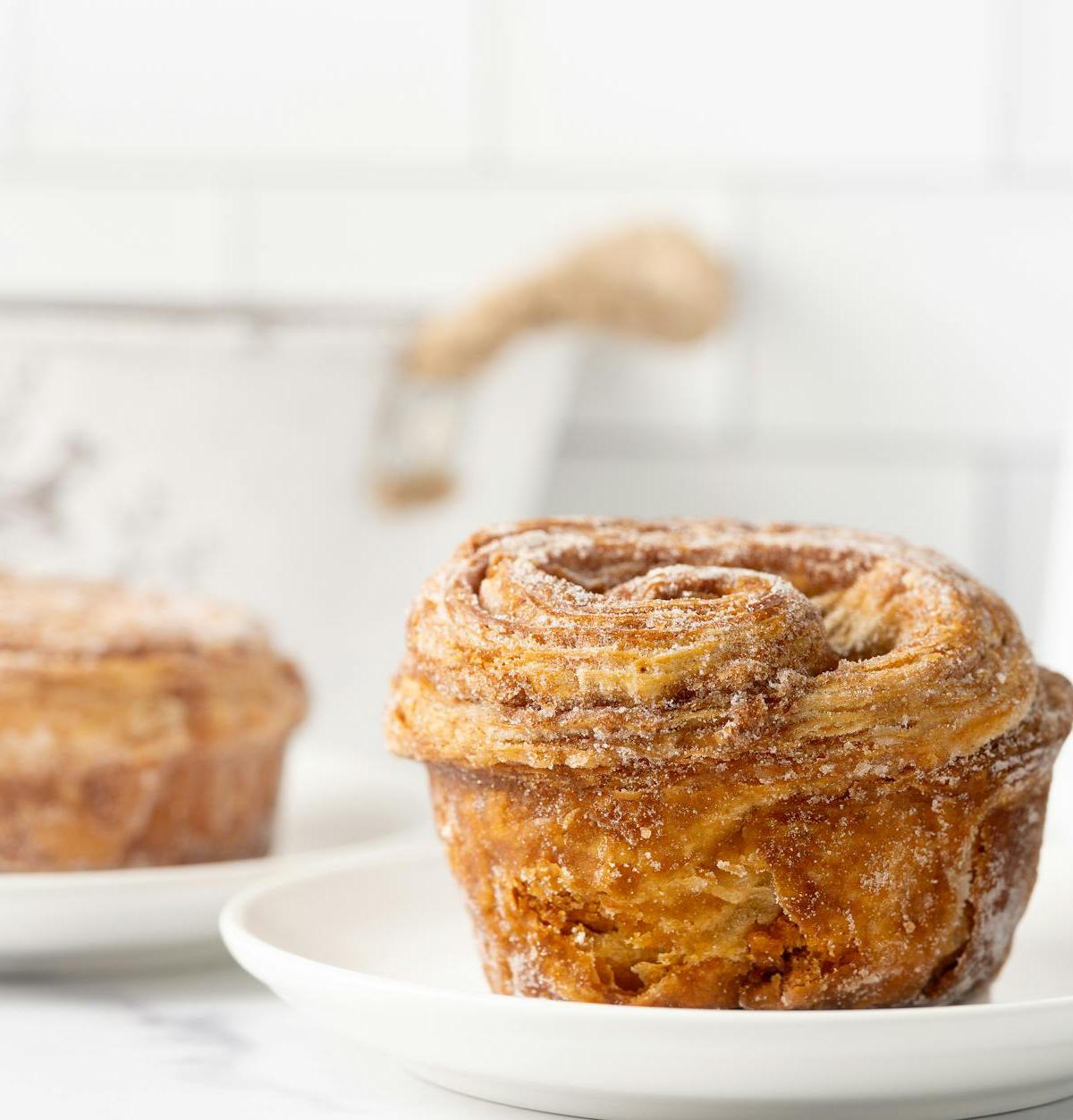
A buttery laminated pastry spiral with cinnamon-sugar filling and caramelized edges. These showstopping breakfast treats require patience but reward you with shatteringly crisp, impossibly flaky layers.
- Total time
- 480 min
- Servings
- 12
- Calories
- 285
- Protein
- 4g
Ingredients
- 2.5 cups all-purpose flour
- 2 tablespoons granulated sugar
- 1.5 teaspoons fine sea salt
- 1.5 teaspoons instant yeast
- ¾ cup whole milk, warmed to 75°F
- 2 tablespoons unsalted butter, softened
- 6 ounces unsalted butter, cold and cubed
- ½ cup granulated sugar
- 1.5 teaspoons ground cinnamon
- 2 tablespoons unsalted butter, melted
- ½ teaspoon fleur de sel or finishing salt
Instructions
- 1
In a large mixing bowl, whisk together 2.5 cups all-purpose flour, 2 tablespoons granulated sugar, 1.5 teaspoons fine sea salt, and 1.5 teaspoons instant yeast. Make a well in the center and pour in 0.75 cup whole milk that's been warmed to about 75°F (test by dipping your pinky — it should feel just slightly warm, not hot).
- 2
Using a wooden spoon or the dough hook attachment on a stand mixer, mix until a shaggy, slightly sticky dough forms. Add 2 tablespoons softened unsalted butter and continue mixing on medium-low speed for 6-8 minutes until the dough becomes smooth, elastic, and pulls away from the sides of the bowl. It should feel tacky but not wet — if it clings heavily to the bowl, dust in 1 tablespoon more flour.
- 3
Turn the dough onto a lightly floured work surface and knead for 1-2 minutes by hand until it comes together into a cohesive ball. Shape it into a rough rectangle and wrap tightly in plastic wrap. Refrigerate for at least 30 minutes — this rests the gluten and makes it easier to work with.
- 4
Unwrap the chilled dough and place it on a lightly floured surface. Pat it into a 10-by-8-inch rectangle. You're now beginning the lamination process — this is what creates the flaky layers. Remove 6 ounces cold unsalted butter from the fridge and cut it into small cubes.
- 5
Distribute the cold butter cubes evenly across the surface of the dough. Fold the dough in thirds like a letter — fold the right third over the center, then fold the left third over top. Rotate the dough 90 degrees so the seam faces you. This completes your first 'turn.' Wrap in plastic and refrigerate for 30 minutes.
- 6
Remove the dough from the fridge and repeat the folding process: pat it lightly into a rectangle about 10-by-8 inches, fold in thirds (right over center, left on top), rotate 90 degrees, wrap, and refrigerate for 30 minutes. This is your second turn.
- 7
Repeat the fold-and-rest cycle two more times (turns 3 and 4), refrigerating for 30 minutes between each turn. After the fourth turn, wrap the dough in plastic and refrigerate for at least 2 hours, or up to overnight — longer resting makes for even more tender lamination.
- 8
Line a 12-cup muffin tin with parchment paper squares (cut 3-by-3-inch squares and press gently into each cup so they line the bottom and sides). Prepare your filling: in a small bowl, whisk together 0.5 cup granulated sugar and 1.5 teaspoons ground cinnamon until evenly combined.
- 9
Remove the laminated dough from the fridge and place it on a lightly floured work surface. Roll it out into a 12-by-10-inch rectangle, working gently so you don't deflate the layers — if the dough resists, let it rest for 5 minutes and try again.
- 10
Brush the entire surface of the dough with 2 tablespoons melted unsalted butter, leaving a 0.5-inch border on all sides. Sprinkle the cinnamon-sugar mixture evenly over the buttered surface — it should look generously covered.
- 11
Starting from the long side closest to you, tightly roll the dough into a log, using light pressure to keep the layers intact. Once rolled, use a sharp knife or bench scraper to cut the log into 12 equal pieces (each roughly 1 inch wide).
- 12
Place each spiral, cut-side up, into a parchment-lined muffin cup. The dough should fit snugly. Loosely cover the tin with plastic wrap and let the pastries rise at room temperature (68-72°F) for 3-4 hours, until they've puffed noticeably and the dough springs back slowly when you poke it gently — this is the final proof.
- 13
About 30 minutes before baking, preheat your oven to 375°F. Position the oven rack in the middle. Check that the proofed pastries look puffy and light — they should feel airy when you gently touch them.
- 14
Uncover the muffin tin and place it in the preheated 375°F oven. Bake for 18-22 minutes, until the tops are deep golden brown and you can smell the rich caramel aroma rising from the tin. The pastries should look dry on top with a slight sheen from the caramelized sugar. If the edges brown too quickly, loosely tent the tin with foil for the last 5 minutes.
- 15
Remove the tin from the oven and immediately sprinkle the tops of each pastry with a tiny pinch of fleur de sel — about 0.5 teaspoon total distributed across all 12. The salt enhances the sweet-salty contrast.
- 16
Let the pastries cool in the muffin tin for 3-5 minutes — they'll be extremely fragile while hot. Lift each one out using the parchment paper and transfer to a wire cooling rack. Serve warm or at room temperature within 4 hours for peak crispiness and flakiness.
Tools you’ll need
- large mixing bowl
- wooden spoon or stand mixer with dough hook
- plastic wrap
- rolling pin
- 12-cup muffin tin
- parchment paper
- sharp knife or bench scraper
- wire cooling rack
- small bowl
- whisk
- pastry brush
- oven thermometer
Cook smarter
Get matched recipes for what’s in your fridge
CookSnap is a free iOS app that finds real recipes from the ingredients you already have. No more grocery-list aspirations.