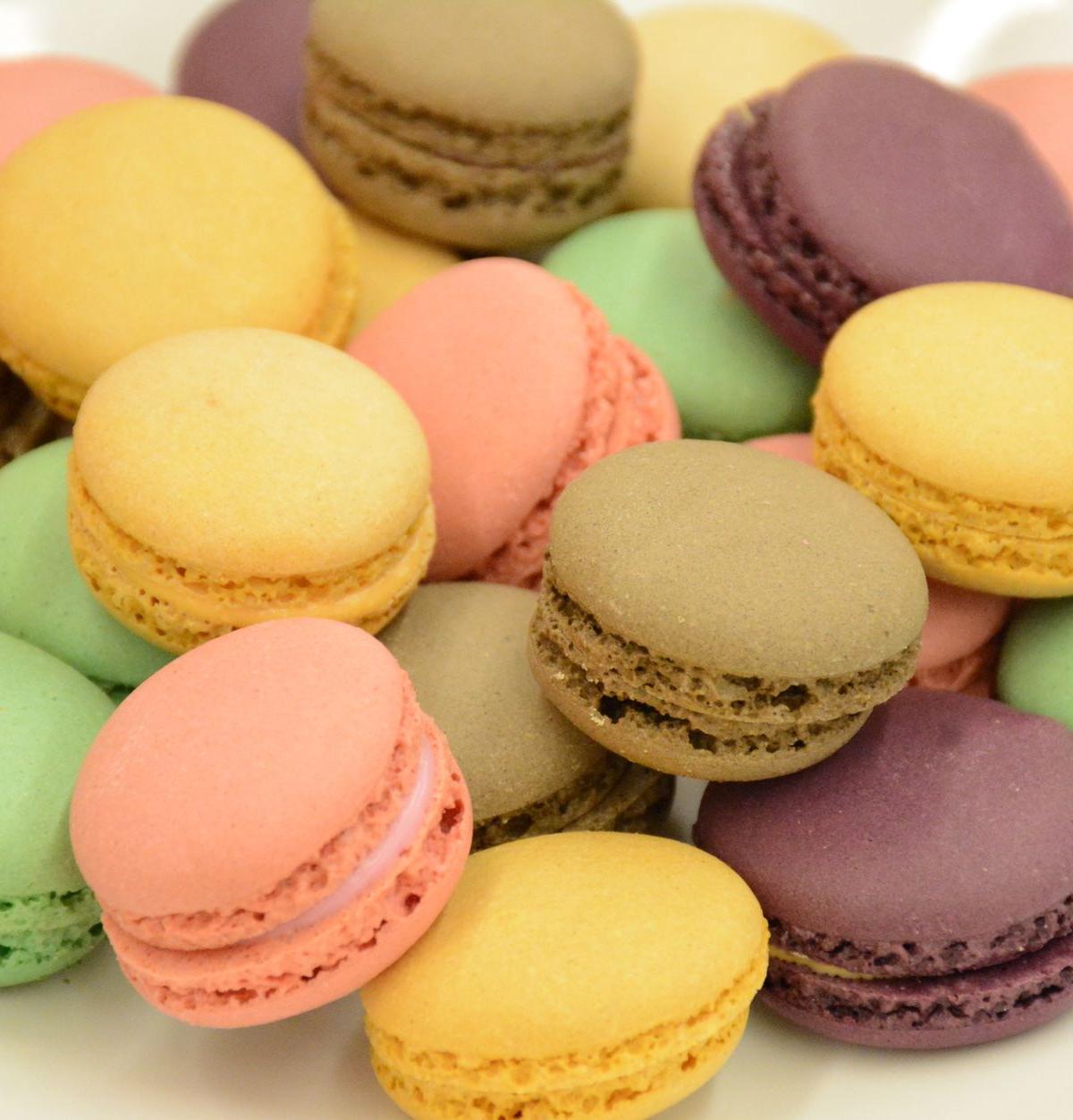
Classic French Macarons
Delicate almond meringue cookies with crispy shells and chewy centers, finished with a silky ganache filling. A showstopper French confection that proves technique matters more than time.
- Total time
- 45 min
- Servings
- 24
- Calories
- 95
- Protein
- 2g
Ingredients
- 3 count large egg whites, room temperature
- 75 g granulated sugar
- 100 g almond flour, finely ground
- 100 g powdered sugar
- ¼ tsp kosher salt
- 100 g dark chocolate, 70% cacao, chopped
- 100 ml heavy cream
- 10 g unsalted butter, softened
Instructions
- 1
Line two baking sheets with parchment paper. Position your oven racks to the upper-middle and lower-middle positions, then preheat to 300°F (150°C). Sift together 100g almond flour and 100g powdered sugar into a small bowl, pressing through any lumps with the back of a spoon — this removes unwanted gritty bits that would create bumpy shells.
- 2
Ensure your 3 large egg whites are truly at room temperature (cold whites won't whip properly) and place them in a completely clean, dry mixing bowl with 0.25 tsp kosher salt. Any trace of grease or yolk will prevent the whites from reaching stiff peaks, so wipe the bowl with a paper towel dampened in white vinegar if needed.
- 3
Using an electric mixer on medium-high speed, whip the 3 egg whites with the salt until they form soft peaks that gently curl over when you lift the beaters — this takes about 2-3 minutes. You should see pillowy, glossy foam that just begins to hold its shape.
- 4
Increase the mixer speed to high and slowly sprinkle in 75g granulated sugar, one tablespoon at a time, beating continuously. This gradual addition ensures the sugar dissolves completely and stabilizes the meringue. Stop when you reach stiff, glossy peaks that form sharp tips when you lift the beaters — the mixture should look like bright white satin and hold its shape perfectly.
- 5
Using a flexible spatula, gently fold the sifted almond flour mixture into the meringue in three additions. Fold by cutting down through the center, scraping along the bottom of the bowl, and folding the bottom portion over the top — rotate the bowl and repeat. After each addition, fold until just combined; the batter should gradually transform from thick and chunky to smooth and flowing.
- 6
Continue folding for an additional 10-15 gentle strokes after all the almond flour is incorporated. The finished batter should fall slowly from the spatula like lava, flowing into itself without breaking apart — this is called the macaronage. If it's too thick and chunky, you'll get nipples on top; if it's too thin, the shells will spread and flatten.
- 7
Transfer the batter to a pastry bag fitted with a round #12 piping tip (or any 0.5-inch round tip). Holding the bag perpendicular to the parchment paper at a 90-degree angle, pipe 1.5-inch diameter rounds onto the prepared sheets, spacing them 1.5 inches apart. Let the piping tip touch the paper, then lift straight up and away quickly. You should have about 24 shells total.
- 8
Let the piped shells rest at room temperature for 20-30 minutes. During this time, a thin, papery skin will form on the surface — tap one shell gently with your finger; it should feel dry to the touch and not stick to your skin. This crucial rest prevents the shells from spreading and helps them develop their signature ruffled 'feet.'
- 9
Place one baking sheet on the upper-middle rack and one on the lower-middle rack. Bake for 14-16 minutes, rotating the sheets halfway through (swap positions and turn front to back). The shells are done when they feel crispy on top and a foot has formed around the base — they should not color at all. They will seem soft when warm; this is normal.
- 10
Remove both sheets from the oven and let the shells cool on the parchment for at least 5 minutes before transferring to a wire rack. Once completely cooled, they should peel away easily from the paper. If they stick, the shells are slightly underbaked — let them cool a bit longer.
- 11
While the shells cool, make the ganache. Place 100g chopped dark chocolate (70% cacao) in a small heatproof bowl. Heat 100ml heavy cream in a small saucepan over medium-high heat until it just begins to steam and small bubbles form around the edges — do not let it boil.
- 12
Pour the hot cream over the chopped chocolate and let it sit undisturbed for 1 minute — the heat will soften the chocolate. Gently stir with a spatula until the chocolate is completely melted and the mixture is smooth and shiny.
- 13
Add 10g softened unsalted butter and stir until fully incorporated. Let the ganache cool to room temperature, stirring occasionally, until it reaches the consistency of thick pudding — about 10-15 minutes. It should hold a peak when you lift the spoon but still be pipeable.
- 14
Transfer the ganache to a piping bag fitted with the same round #12 tip. Match the cooled shells into pairs of similar size. Pipe a small mound of ganache (about 0.5 teaspoon) onto the flat side of one shell, then press the flat side of a matching shell gently on top, twisting slightly to secure.
- 15
Place the assembled macarons on a serving platter. They can be eaten immediately, but flavor develops over 24 hours as the shells soften slightly and the ganache sets — store in an airtight container at room temperature for up to 3 days, or refrigerate for up to 1 week.
Tools you’ll need
- two baking sheets
- parchment paper
- fine-mesh sieve
- mixing bowl
- electric mixer
- flexible silicone spatula
- pastry bag
- round #12 piping tip
- wire cooling rack
- small heatproof bowl
- small saucepan
- instant-read thermometer (optional)
- serving platter
- airtight container
Cook smarter
Get matched recipes for what’s in your fridge
CookSnap is a free iOS app that finds real recipes from the ingredients you already have. No more grocery-list aspirations.