Baklava
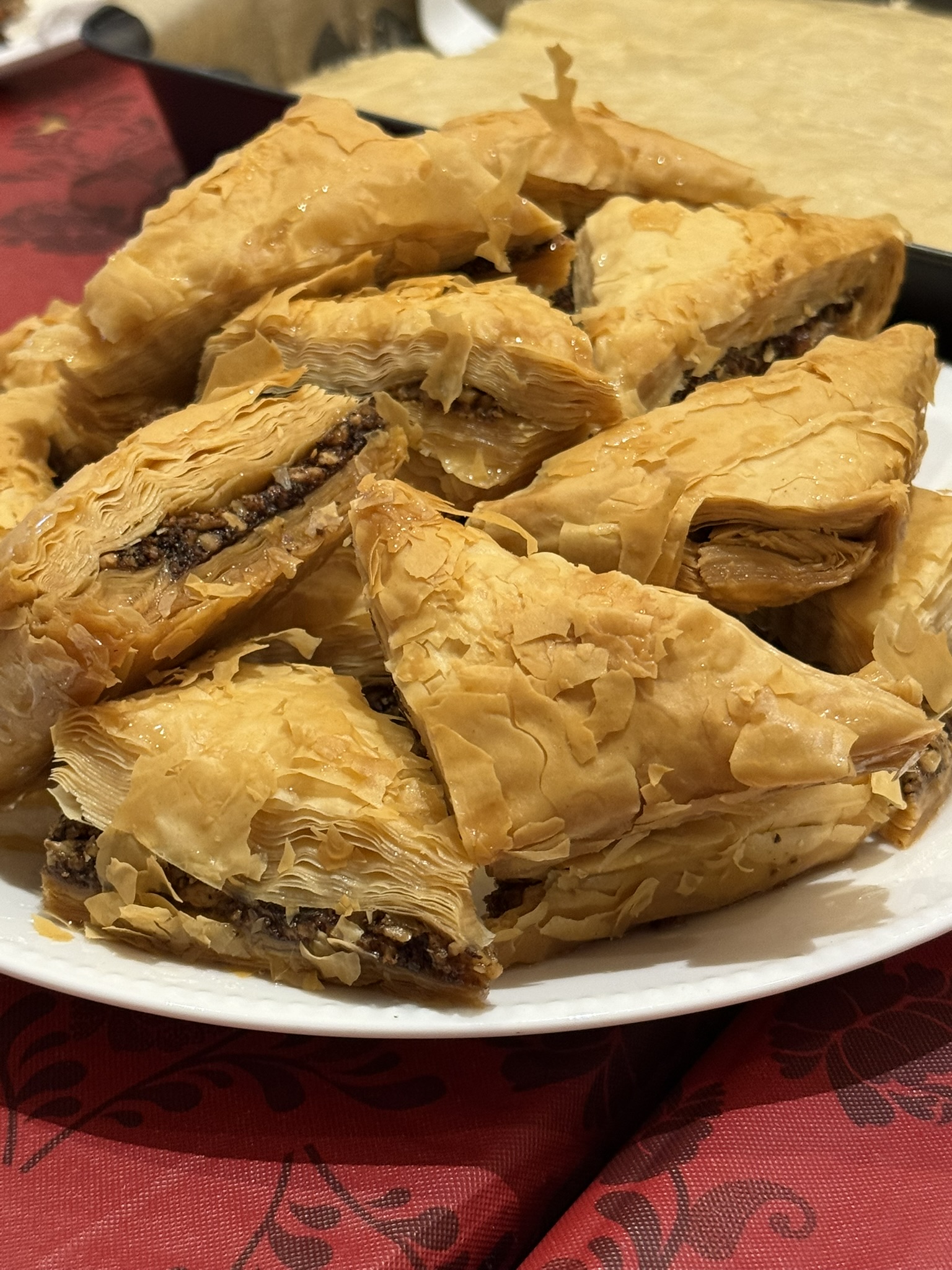
Layers of paper-thin phyllo dough brushed with butter, filled with spiced chopped walnuts, baked until shatteringly golden, then immediately soaked in cold honey syrup. The syrup is poured cold over hot baklava — that temperature contrast is what makes the layers absorb it cleanly without turning soggy.
- Total time
- 120 min
- Servings
- 24
- Calories
- 290
- Protein
- 4g
Ingredients
- 1 cup water
- 1 cup granulated sugar
- ½ cup honey — use a good quality, floral honey; it is the dominant flavor in the finished dessert
- 1 tbsp fresh lemon juice
- 1 cinnamon stick
- 3 whole cloves (optional)
- 1 lb walnuts, finely chopped — about 4 cups (pulse in a food processor until fine but not pasty; you want small, distinct pieces, not walnut dust)
- 1 1 tsp ground cinnamon
- ¼ tsp ground cloves
- 1 2 tbsp granulated sugar
- 1 lb package phyllo dough (about 40 sheets), thawed overnight in the refrigerator then brought to room temperature for 1 hour before using — do not skip this step; cold phyllo cracks, room-temperature phyllo is pliable
- 1 cup unsalted butter (2 sticks), melted and kept warm
Instructions
- 1
Make the honey syrup the day before or at least 2 hours before you plan to serve, because the syrup must be completely cold when poured over the hot baklava. In a medium saucepan, combine the water, sugar, honey, lemon juice, cinnamon stick, and cloves. Bring to a boil over medium-high heat, stirring until the sugar fully dissolves. Reduce heat to medium-low and simmer without stirring for 5 minutes. Remove from heat, discard the cinnamon stick and cloves, and let the syrup cool completely at room temperature. Then refrigerate until ready to use — it must be cold.
- 2
In a bowl, combine the finely chopped walnuts, cinnamon, ground cloves, and sugar. Stir to distribute the spices evenly through the nuts. Set aside.
- 3
Preheat the oven to 325°F. Brush the bottom and sides of a 9x13-inch metal baking pan generously with melted butter.
- 4
Unroll the phyllo sheets and lay them flat on a clean surface. Cover the stack immediately with a damp kitchen towel — phyllo dries out in minutes when exposed to air and will become brittle and crumble when you try to layer it. Work quickly, keeping the unused stack covered at all times.
- 5
Begin layering: place one sheet of phyllo flat in the buttered pan. Using a pastry brush, coat the entire surface with melted butter, reaching all the way to the edges and corners. Place the next sheet on top and butter it. Repeat until you have 10 buttered sheets forming the base layer. Take your time with the butter — each layer needs to be coated fully or the finished baklava will have uneven, dry patches.
- 6
Spread one-third of the walnut filling evenly over the base layer of phyllo, pressing it gently so it forms a uniform layer.
- 7
Add 5 more sheets of phyllo, buttering each one individually. Spread another third of the walnut mixture on top. Add 5 more buttered sheets, then the final third of the walnut mixture. Finish with the remaining phyllo sheets, buttering each one as you go — aim for 10 to 12 sheets for the top layer.
- 8
Before baking, score the baklava with a very sharp knife. This is critical — cutting through raw phyllo is far easier than cutting through baked phyllo, which shatters. Cut lengthwise into 4 even strips, then cut diagonally across to create diamond shapes, or cut crosswise for square pieces. Cut only halfway through the layers at this stage; you will finish cutting all the way through after baking.
- 9
Bake at 325°F for 1 hour to 1 hour 15 minutes until the top is deeply golden brown throughout — not pale gold, but rich amber. All layers should be fully crisp. If the top is browning too quickly, tent loosely with foil and continue baking.
- 10
Remove the baklava from the oven. Immediately — while it is still screaming hot — slowly ladle the cold honey syrup over the surface, following the cut lines so it seeps into every layer. Pour gradually and steadily rather than all at once. You should hear the syrup sizzling as it hits the hot pastry. This temperature contrast — cold syrup on hot baklava — is the specific technique that allows the phyllo to absorb the syrup without turning soft.
- 11
Let the baklava cool completely at room temperature for at least 4 hours, or ideally overnight. Do not cover with plastic wrap while still warm or it will steam and soften. The baklava improves significantly with time as the syrup finishes absorbing. Finish cutting all the way through the scored lines before serving.
Cook smarter
Get matched recipes for what’s in your fridge
CookSnap is a free iOS app that finds real recipes from the ingredients you already have. No more grocery-list aspirations.