Why “AI Recipes” Is Becoming a Red Flag in the App Store
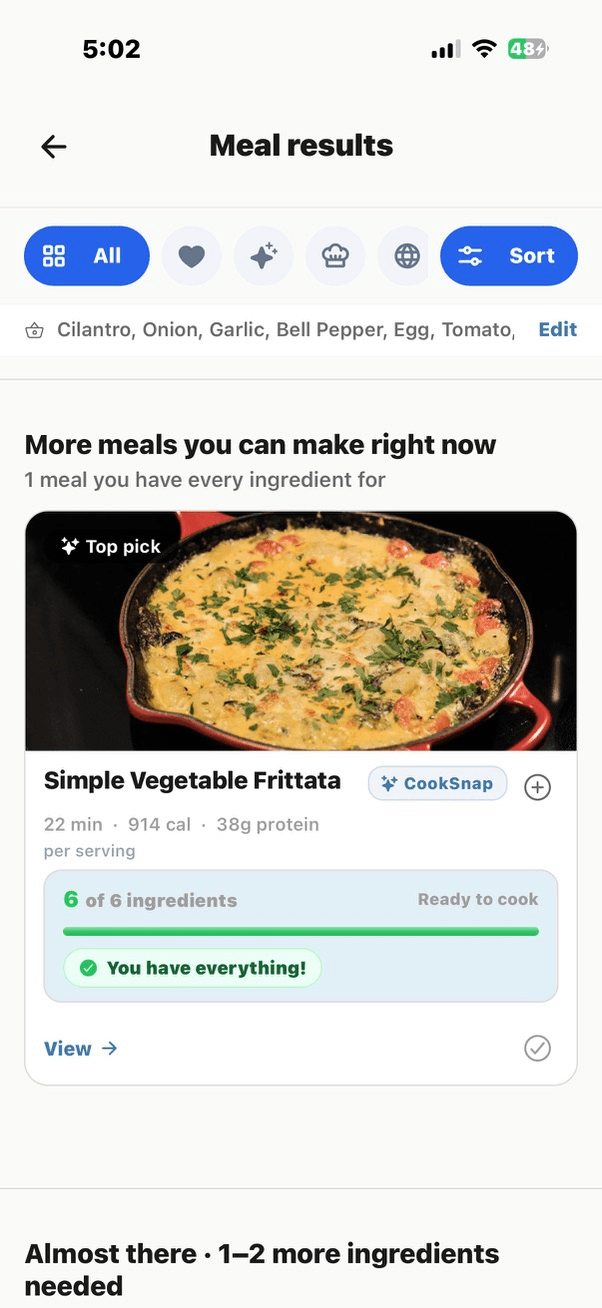
Scroll through the food category on the App Store for ten minutes and you’ll see the same eight phrases on the screenshots: “AI-powered recipes,” “personalized AI chef,” “AI meal generator,” “ChatGPT for cooking.” Eighteen months ago, these phrases were a feature. They were a differentiator. They earned downloads.
Now they’re a red flag. Our user research shows a pretty sharp inflection point around late 2025: prospective users who had previously cited “AI” as a positive cue started citing it as a reason to skip an app. Here’s our reading of what happened.
The cycle, compressed
Three phases in roughly two years:
- The novelty phase. ChatGPT lands. People are delighted by the idea of asking a computer to write them a recipe. AI cooking apps capture the spike.
- The saturation phase.Every recipe app becomes an “AI” recipe app. The differentiation collapses. The phrase “AI” becomes background noise on every screenshot.
- The disillusionment phase.Users have now actually cooked from generative recipes. They’ve had the dishes that subtly didn’t work. They’ve had the recipes that asked for an ingredient they didn’t input. “AI” in cooking now signals “probably hallucinated” to a sizable chunk of the market.
We’re in the third phase. We’re building a product in it.
The cooking-specific problem with “AI” as a label
Other AI products have crossed the disillusionment chasm. AI translation is still labeled AI translation and people use it confidently. AI photo editing didn’t lose its market.
The difference: in those domains, the user can verify the output immediately. They can read the translated sentence. They can look at the edited photo. They know within a second whether it’s right.
With recipes, the verification step is cooking the meal. Forty-five minutes. Ingredients you bought. Effort you spent. By the time you know the recipe was bad, the cost is sunk. The asymmetry between “quick to generate” and “slow to verify” is brutal for AI labels in cooking specifically.
What we call Custrd instead
We obsess about this. The honest framing of our product is “visual ingredient detection + retrieval against a curated library.” That’s a mouthful. It’s also not what marketing copy is allowed to say.
The phrases we’ve been testing on the App Store listing:
- “Snap your fridge. Find a real recipe.”
- “Recipes that match what you actually have.”
- “Real recipes, matched by photo.”
- “No AI-generated meals.”
The last one is the surprising one. “No AI-generated meals” as positioning copy. We’d have thought a year ago that this would alienate the AI-positive cohort. It hasn’t. The AI-positive cohort still finds us because our actual technology stack uses computer vision and retrieval-augmented matching, which is “AI” in any honest definition. They show up because the product works. They don’t need the marketing line.
The AI-skeptical cohort, meanwhile, hits the “no AI-generated meals” line and stops scrolling. They download. They convert at higher rates than the AI-positive cohort did when we used to lead with “AI-powered.”
A prediction we’re willing to publish
Over the next 18 months we expect “AI” in cooking- app titles to drop by about 40-60%. The apps that survive will either rename their positioning around the actual capability (visual identification, retrieval, personalization) or re-emerge as “recipe AI” products with explicit verification mechanisms attached — user reviews, recipe- author attribution, real-world testing badges.
Generic “AI recipes” will be the cooking-app equivalent of “blockchain.” A phrase that worked for eighteen months until it stopped.
We are not anti-AI. We use AI for ingredient detection. We use AI to enrich recipe metadata. We use AI to triage user-reported recipe issues. But we’re very, very careful not to use AI to invent recipes, and we’re even more careful not to say we do. The category’s credibility is fragile right now. We’d like to be one of the apps that survives the backlash.
If this resonates — if you’ve quietly stopped trusting AI cooking apps too — try the free recipe finder once. Tell us if it feels different.